
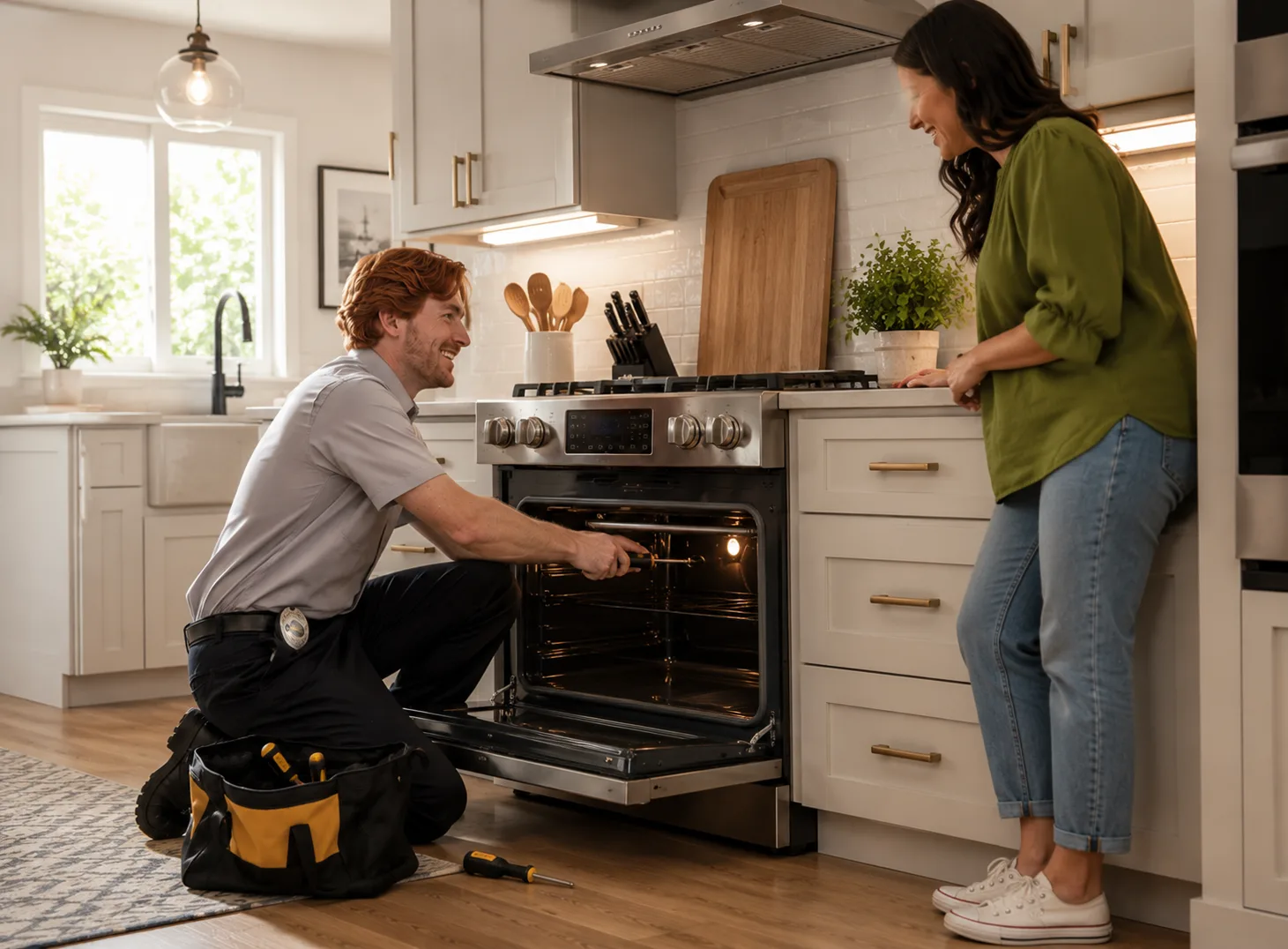
The Short Answer
Electric oven cold: inspect the bake element for blisters or breaks — it fails visibly more often than not. Gas oven cold: watch whether the igniter glows without ever lighting the burner, the signature of a worn igniter. Oven heats but bakes badly: test the true temperature with a standalone thermometer, because a drifting sensor lies to the control board. All four faults are routine single-visit repairs.
The Four Suspects
| Component | How It Gives Itself Away | The Repair |
|---|---|---|
| Bake element (electric) | Blisters, breaks, or a section that stays dark while the rest glows | Same-visit swap — the most replaced oven part in existence |
| Broil element (electric) | Top browning gone while bottom heat works normally | Same-visit swap, identical job one shelf higher |
| Igniter (gas) | Glows orange for 90+ seconds without the whoosh of the burner lighting | Weak igniters fail gradually — replacement restores instant lighting |
| Temperature sensor | Cakes sunken, cookies burnt at the edges, roasts perpetually undercooked | Sensor replaced and readings verified against a calibrated probe |
| Thermostat / control board | Preheat never finishes, or the display temperature ignores reality | Diagnosed with measurements, not guesses — then quoted flat-rate |
Electric: The Element Inspection
Kill the breaker, open the door, and study the black loop along the oven floor. A healthy bake element is smooth and uniform; a failed one wears its death openly — bubbled sections, ash-grey pits, or an outright gap in the metal. Run a preheat (power restored, hands out) and watch for a patch that never glows while its neighbours turn orange. One caution worth taking seriously: an element that has arced and burned once can arc again, so a visibly damaged loop should stay off until it is replaced rather than nursed through another week of casseroles.
Gas: Watch the Igniter Work
Start a bake cycle and observe through the open lower panel or broiler drawer. The sequence should read: igniter glows, roughly thirty to sixty seconds pass, then the burner lights with a soft whump. An igniter glowing beyond the ninety-second mark with no flame is drawing too little current to convince the safety valve to open — the defining symptom of igniter old age. It is a gradual failure, which is why “the oven has been slower lately” so often precedes “the oven quit.” The stovetop version of this story has its own bulletin: gas burners that click without lighting.
“An igniter never dies on a quiet Tuesday — it waits for the turkey. Book the slow preheat before it becomes the no-heat.”
Field note — The Technician Team
Uneven Baking and Temperature Drift
An oven that heats but cannot hold temperature ruins food more subtly: pale tops, scorched bottoms, bakes that need “just five more minutes” three times over. A five-dollar standalone thermometer exposes it — set 350°F, wait twenty minutes, read the truth. Gaps beyond twenty degrees or readings that wander mid-bake indict the temperature sensor, and door problems masquerade here too: a gasket or hinge leaking heat mimics a sensor fault convincingly, which is why the oven door bulletin is the companion read. Persistent drift earns a visit from our stove and oven repair technicians in Sherwood Park — sensor swapped, oven calibrated, evidence verified before we leave.
Oven Heat Questions
Why is my electric oven not heating but the stovetop works?
The two systems are independent — working burners only prove the appliance has power. Inside the oven cavity, inspect the bake element with the power off: bubbling, pitting, or a visible break means it has burnt through. An element that looks perfect can still be dead, which is where a technician’s continuity test settles it in seconds.
Why does my gas oven take forever to heat up?
An aging igniter draws less current as it weakens, so the safety valve opens late and reluctantly — preheat stretches from twelve minutes to thirty, then one day the burner never lights at all. Watching the igniter glow without ignition for more than about ninety seconds is the diagnostic; replacement returns preheat to normal.
How do I know if my oven temperature sensor is bad?
Set the oven to 350°F and check it with an inexpensive standalone oven thermometer after twenty minutes. A gap of more than 15–20 degrees in either direction, or temperatures that drift during a bake, implicate the sensor or thermostat. Consistent, repeatable results from that little thermometer are exactly the evidence a technician wants to hear on the phone.