
The Short Answer
Choose ducted venting whenever a path to the outdoors exists — it removes steam, grease, and odour instead of filtering and returning them. Size the fan to your cooking (about 100 CFM per linear foot of range as a working rule, more for gas), hang the hood 24–30 inches over electric or 26–32 over gas, and anchor it into studs — never drywall alone. Recirculating models are the honourable fallback for condos where ducting is impossible.
Ducted vs. Recirculating: Two Philosophies
| Factor | Ducted (Vented) | Recirculating (Ductless) |
|---|---|---|
| Where the air goes | Outside the house, grease and steam included | Back into the kitchen through charcoal filters |
| Effectiveness | The clear winner — removes moisture, not just odour | Softens smells; humidity stays in the room |
| Installation demand | Needs a duct path through cabinet, wall, or ceiling | Mounts anywhere; filters swap in minutes |
| Ongoing cost | Occasional duct cleaning | Charcoal filters replaced two to four times a year |
| Right choice when… | A vent path exists or can reasonably be made | Condos and rentals where ducting is impossible |
Sizing the Airflow
Hood capacity is measured in CFM — cubic feet of air moved per minute — and undersizing is the silent norm. The working arithmetic: around 100 CFM per linear foot of cooktop for electric, with gas ranges demanding more because their burners add combustion byproducts to the steam and grease (one common rule adds 100 CFM for every 10,000 BTU). A serious caveat lives at the top end: hoods beyond roughly 400 CFM can depressurize a tightly sealed Alberta home enough to backdraft a furnace or water heater, which is when make-up air enters the conversation — a detail a professional install accounts for and a box-store impulse buy does not.
Mounting Is Structural Work
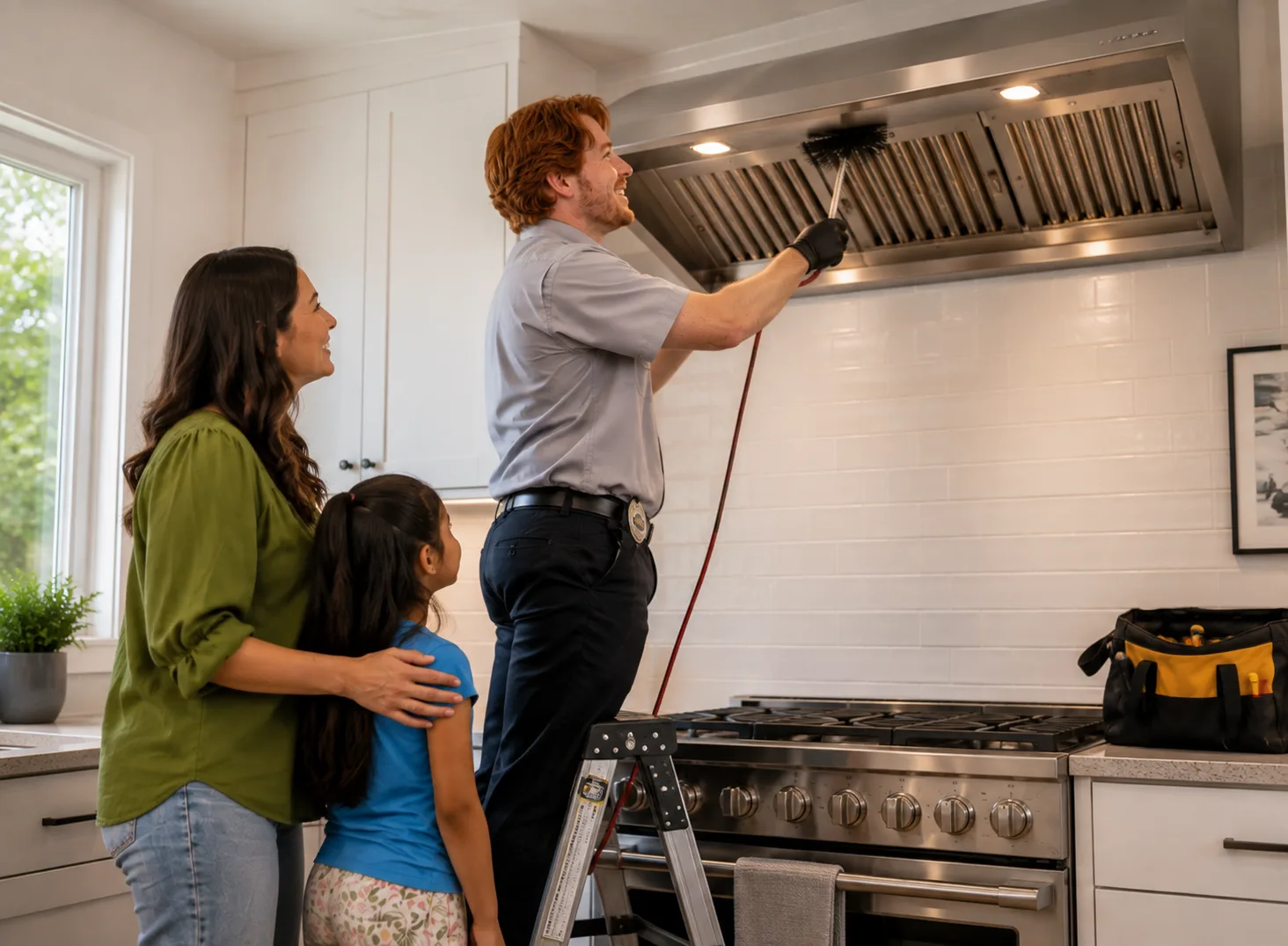
Everything about a hood fights its mounting: motor vibration, thermal cycling from the cooktop below, and — for OTR units — twenty-plus kilograms of cantilevered appliance. Screws into bare drywall lose that fight within a season. Proper installation finds studs or adds a backing plate, keeps the duct run short with gentle bends, seals joints with foil tape, and terminates outdoors through a damped cap that keeps winter air out. It is carpentry, sheet-metal work, and wiring in one compact job — which is exactly why Appliance Repair Sherwood Park treats a hood install with the same rigour as a gas connection.
“A hood that rattles was installed by someone in a hurry — anchored steel over a stove should be as quiet as the cabinet beside it.”
Field note — The Technician Team
The OTR Microwave Case
Over-the-range microwaves bolt the ventilation question to a second appliance, and the install reflects it: a wall bracket carrying the rear edge, bolts descending through the cabinet above, two people lifting in coordination, and the vent configured for outside exhaust, recirculation, or top discharge depending on your kitchen's anatomy. Done well, it reclaims counter space without sagging a millimetre in a decade. Every mounting and venting variation is part of our appliance installation service — and once your hood is working, keeping its filters and duct clean pairs naturally with the dryer vent cleaning routine on the yearly maintenance calendar.
Hood Questions, Answered
How high should a range hood be above the stove?
The working band is roughly 24 to 30 inches above an electric cooktop and 26 to 32 above gas — always deferring to the manufacturer’s sheet for the exact model. Hang it too low over gas and the hood itself becomes a heat problem; too high and capture drops off sharply, leaving steam to roll past it onto the cabinets.
Can a range hood vent into the attic?
No — and this shortcut appears in more Sherwood Park attics than anyone would like. Pumping grease-laden, humid air into an enclosed attic feeds mold, saturates insulation, and coats framing in residue. Ducted means ducted to the outdoors, through a proper roof or wall cap with a damper; anything less is recirculating with extra steps and consequences.
Is an over-the-range microwave as good as a range hood?
It trades ventilation power for counter space. OTR microwave fans move less air than a dedicated hood and sit higher than ideal capture height, but for many kitchens the two-in-one is the practical choice. If you cook heavily — searing, wok work, canning season — a true hood earns its cabinet space; either way, the mounting and venting deserve the same professional care.